download
Gene Expression Data Quality is Shaped Before Analysis: How Upstream Decisions Influence Downstream Results
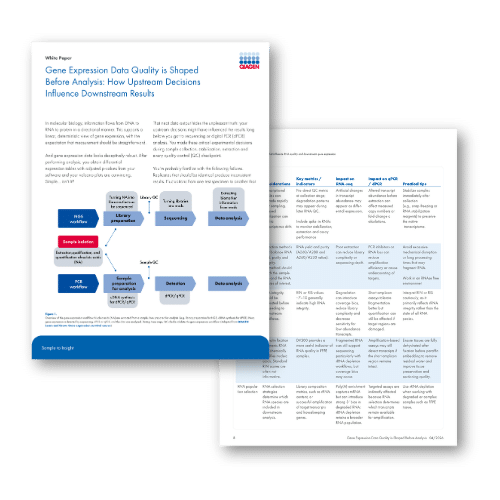
Explore the hidden pitfalls that could be derailing your gene expression analysis in this whitepaper outlining the key challenges you'll come across.
When gene expression results look inconsistent or biologically implausible, most researchers turn to normalization, batch correction, or statistical modeling.
But gene expression data quality is strongly influenced by decisions made much earlier in the workflow.
From sample collection and stabilization to RNA extraction and quality control (QC), each step affects which RNA species are preserved and how accurately they are represented in downstream NGS, qPCR, or dPCR analyses. Degradation, transcriptomic drift, selective RNA loss, and misinterpreted QC metrics can introduce biases that become apparent only during analysis.
Upstream issues often manifest downstream as reduced library complexity, coverage bias, and rRNA contamination in NGS, or as undercounting and amplification inefficiencies in dPCR and qPCR workflows.
If you’re designing or troubleshooting a gene expression workflow, this guide will help you evaluate upstream decisions and understand their downstream consequences, so your results more accurately reflect the biology you intend to measure.
In this white paper, you’ll learn:
- The “sample-to-signal” principle and how upstream handling shapes downstream data
- How RNA handling influences target amplification efficiency, NGS library complexity, and coverage bias
- The practical trade-offs between poly(A) selection and rRNA depletion
- Why high RIN does not guarantee meaningful gene expression data
- How RNA-seq, qPCR, or dPCR differ in tolerance to degradation, and what this means for your sample type
- Key challenges in downstream analytical steps
Download the white paper to evaluate whether your current workflow is preserving the biology you think it is.
